Northern Economist 2.0

Monday, 6 April 2026

Port Activity Will Help Stabilize Thunder Bay's Economy in 2026


Despite the snow on the ground, spring has arrived at the Port of Thunder Bay and that means two things.  First, the arrival of the first vessel with the  MV Kathy McKeil passing the breakwall at on March 26.  Second, there is the annual Opening of Navigation Luncheon which will take place this year on April 8th at the Italian Cultural Centre in Thunder Bay. These annual events always remind us of the importance of the Port of Thunder Bay, not only in the past when the twin ports of Port Arthur and Fort William were the largest grain port in the world but at present given the revitalization of the port’s activity since 2000 and especially over the last decade.  As of 2024, the Port provided approximately 1,000 direct jobs and an annual economic impact of $370 million.

It bears looking at some of the recent trends in the main cargo that passes through the port. Figure 1 presents a plot of total tonnage through the port since 2000 along with a LOWESS smooth to isolate the trends and there has been a pronounced upward trend since 2010 with an average annual growth rate in total tonnage of 1.3 percent annually since 2000 and 3.3 percent since 2010.  In 2025, total tonnage through the Port of Thunder Bay was 10.8 million tonnes. 


Of course, the main commodity remains grain accounting in 2025 for 84 percent of total tonnage shipped. Figure 2 presents grain tonnage through the port since 2000 and again with the trend shows an increase after 2010 with a plateauing from about 2016 to 2020 and then another surge bringing total grain tonnage shipped in 2025 to almost 9 million tonnes. From 2000 to 2025, grain tonnage shipped has grown at an annual rate of 1.9 percent but since 2010 the growth rate averaged 4.1 percent annually. Figures 3 and 4 repeat the plots for potash and dry bulk. Since 2000, potash shipments in tonnes have grown at an annual rate of 9.6 percent but since 2010 the growth rate has been 20 percent. Meanwhile, dry bulk since 2000 grew at an annual rate of 7.1 percent with the period since 2010 seeing annual growth of 5.7 percent.  


With the renewed emphasis on east-west trade within Canada along with the disruption in world markets and shipping as a result the ongoing wars in the crucial cross-roads of the Middle East, one expects the demand for Canadian resource products as well as shipments through Thunder Bay to increase in 2026.  This will be a boon to the Thunder Bay economy and a counterweight to the forecasts of tepid growth in 2026 from Signal49 research.The Port of Thunder Bay remains an important component of local and regional economic activity.

Tuesday, 8 April 2025

Thunder Bay’s Port: The Renaissance of The East-West Connection


The Port of Thunder Bay is hosting its annual opening of Navigation Luncheon tomorrow and there is indeed much to celebrate moving into the future even given the current turbulence of the international economic environment.  The port has long been a key piece of infrastructure for Thunder Bay’s economy and is really the main reason that Thunder Bay exists.  Thunder Bay or "The Lakehead" as it was more commonly known was the transshipment point on the east-west economic axis erected by Canadian Confederation and the subsequent national policies that put through a railway linking the agricultural production of the west with the manufacturing production of the east.   

Thunder Bay exists in its current incarnation because of Canada and Canada in turn requires  Thunder Bay as a transport hub.  The role of the port was key in the east-west flow that defined Canada after Confederation.  The chief export product flowing through the Lakehead twin-ports of Port Arthur and Fort William was of course prairie grain but over time there was a diversification into other products though grain was always by far the most important product shipped.  At the peak of the grain trade, dozens of grain elevators lined Thunder Bay’s waterfront and thousands of people worked in either the railways, the grain elevators or the port.

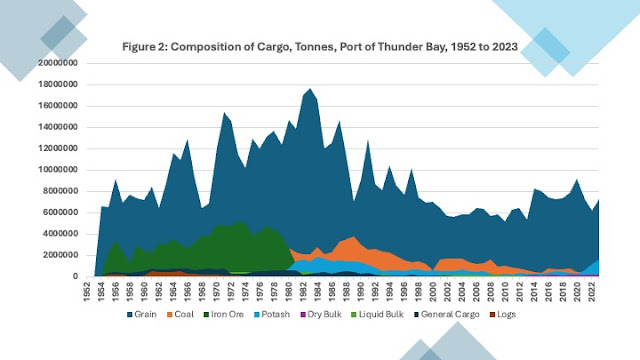
Of course, change has been constant when it comes to the Port of Thunder Bay. And nowhere is that change more evident than in the data compiled and available through the Port Authority itself.  Figure 1 plots total tonnes of cargo from 1952 to 2023 with a polynomial trend fitted. Total tonnes of cargo peaked in 1983, and the port then underwent a decline in total cargo shipped.  Much of this decline was due to a reorientation of the grain trade away from traditional European markets to the Asia-Pacific region which generated more activity for grain facilities in Vancouver and Prince Rupert.  However, as Figure 2 illustrates, it was not just a decline in grain that affected the port but also the end of iron ore mining at Steep Rock in Atikokan as well as the phasing out of coal.  Indeed, as Figure 3 illustrates, grain as a share of total cargo became even more important over time with the linear trend showing an increase from 60 percent of cargo in the mid twentieth century to over 80 percent by the present.


What is also notable in these charts is that since the start of the 21st century, the Port of Thunder Bay has seen a recovery and activity is generally on an upward trend.  While activity is still well removed from the peaks of the early 1980s, the Port of Thunder Bay is poised to increase its role in Canada’s transportation network.  It is probably a coincidence but the decline of the port’s activity in the 1980s also paralleled the increasing north-south orientation of Canada’s economy in the wake of first the Canada-US Free Trade Agreement (1988) and later its NAFTA and CUSMA successors.  However, with the continental economic relationship with the United States under stress and a push to remove inter-provincial trade barriers and increase east-west economic activity within Canada, Thunder Bay and its port are well poised to again build on its historical role as the east-west transportation hub.  Thunder Bay and its port exist because of Canada’s east-west economic orientation and anything that strengthens that link will inevitably benefit the Port of Thunder Bay.  What is good for Canada, is good for Thunder Bay.


Monday, 24 July 2017

Port Activity in Thunder Bay: A Retrospective

Thunder Bay's economic development hinged on its role as a transportation hub and its port was integral to that.  From the early days of the grain trade to the development of the massive elevators that still mark its waterfront, Thunder Bay was vital to the development of the Canadian wheat economy.  At its peak, over thirty grain elevators lined the waterfront in Thunder Bay and it was the largest grain port in the world.  Thunder Bay's port underwent a decline in the 1980s as a result of shifts in global grain markets that persisted  into the early 21st century but recent years have seen a resurgence of both the grain trade and the port.  Indeed, there is new life in the entire St. Lawrence Seaway as a recent piece in the Globe and Mail noted that 2017 has seen a 20 percent increase in freight movement driven by iron ore and grain shipping.