Northern Economist 2.0

Friday, 12 June 2026

Thunder Bay Leading in April Building Permits Data

 Yesterday, Statistics Canada released its building permits data for April 2026 and the ranked April 2025 to April 2026 growth rates reveal that Thunder Bay led the country's CMAs in growth in the value of total building permit values issued in April. Building permit values are an indicator of new investment both in terms of residential as well as non-residential construction (commercial, institutional). Canada as a whole saw a 7.6 percent decrease in the value of permits issued for the month of April - not exactly a good sign for a country that needs to up its investment game not to mention boost residential housing stock.  The total for all CMAs was down 1.7 percent. 

Figure 1 plots the percent change in the seasonally adjusted total value of permits issued between April 2025 and April 2026 for Canada's CMAs ranked from highest to lowest. At the top is Thunder Bay which going from $6.4 million to $25.6 million in value of permits issued had a 300 percent growth rate.  It was followed by Peterborough, ON at 195 percent and then Brantford, ON at 87.3 percent.  Of 43 CMAs, 16 saw an increase in the total value of permits while the remainder saw a decline with the steepest declines in Hamilton, ON and Red Deer, AB at 59 and 80 percent respectively.  The other northern Ontario CMA also saw a decline at 48 percent.  Essentially, two thirds of Canada's CMAs saw a drop in the total value of permits issued while one third saw an increase. Keep in mind that this is just a monthly performance and preliminary at that. 


As well, these are total permit activity values and what is often of more interest given the high rents and housing affordability in general is what kind of growth has there been in residential housing.  This is a different data series ( Statistics Canada Table 34-10-0293-01) and a look at the numbers paints a somewhat different picture.  


Figure 2 shows the ranked percent change in the annual value of total residential construction between 2024 and 2025.  At the top at 69 and 47 percent respectively are Brantford and Quebec City.  About 80 percent of CMAs saw growth in the value of residential construction between 2024 and 2025 which bodes well for supply side fixes to housing affordability in those cities.  Keep in mind that this is total value rather than the number of units which means that even those cities that saw a decline may actually be building more units per capita than cities with an increase in total value of residential construction given differences in building costs and prices. In Figure 2, Thunder Bay is near the bottom with a decline of 2.6 percent while Peterborough is last a -24 percent.  However, one cannot really reach a firm conclusion as to what is going on given the comparison is between somewhat different variables as well as of annualized monthly data with annual totals. 

Overall, still quite interesting numbers.   


Tuesday, 4 May 2021

Reliance on housing investment creates prosperity mirage in Ontario


While Ontario continues to grapple with COVID, there’s light at the end of the tunnel. At some point, government decision-making will move away from pandemic management and towards economic recovery and the need to get Ontario’s economy firing on all cylinders.

In 2020, Ontario’s nominal GDP dropped by nearly 5 per cent. Ontario’s spring 2021 budget forecasts a rebound in 2021 of slightly more than 6 per cent followed by another 6 per cent in 2022. However, it’s premature to conclude that happy days are here again given the long-term economic and productivity issues in Ontario.

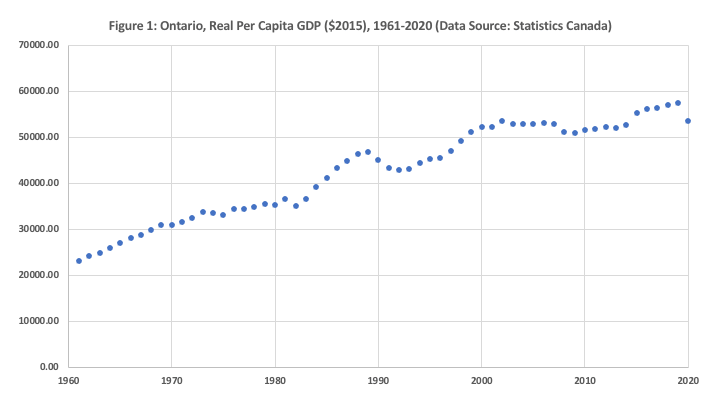
The first chart below presents Ontario’s real per capita GDP (in 2015 dollars) starting in 1961 to provide a long-term perspective.

Figure 1

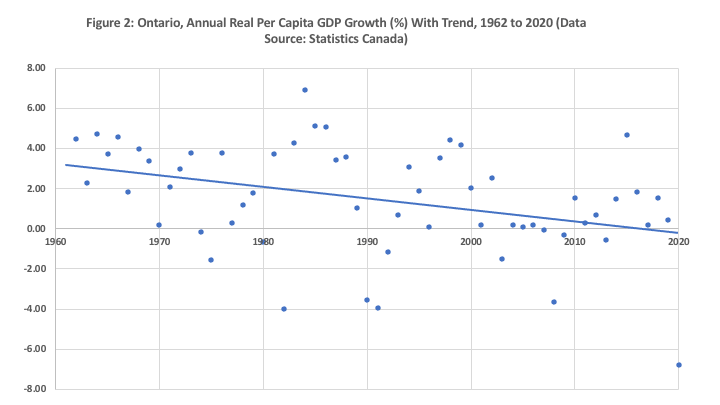
The second chart presents the annual growth rate of real per capita GDP with a linear trend. The picture is actually rather grim as it shows a long-term decline in real per capita GDP growth. Between 1961 and 1991, Ontario’s real per capita GDP rose from $23,218 to $43,357—an increase of 87 per cent. However, over the next 30 years, real per capita GDP only grew an additional $10,094 dollars—an increase of only 23 per cent.

Figure 2

Whereas the 1990s saw a rebound after the dip of the 1990-91 recession, growth essentially flattened for the 15-year period from about 2000 to 2015. A recovery seems to have begun in growth in 2015 but then 2020 alone saw real per capita GDP take a 7 per cent hit.

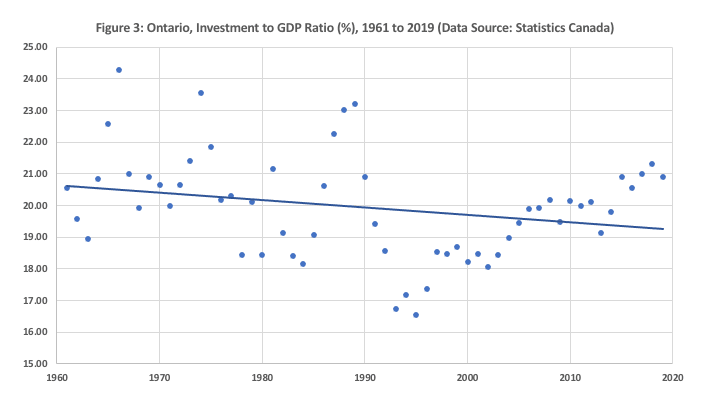
A lot has happened in Ontario over the last 30 years that factor into the reasons for the long-term growth and productivity decline (which is not unique to Ontario). Indeed, trying to get real GDP growth above 2 per cent is a problem not only for Ontario but also Canada and many advanced economies. However, the key issue for Ontario can be summarized by in the third chart below, which shows a long-term decline in the investment-to-GDP ratio in the province over time. Ontario has reduced the share of output devoted to new investment.

Figure 3

Productivity growth requires new investment in productive capital—plant, machinery and equipment—and the period from 1960 to 2000 saw it decline from highs near 25 per cent of GDP to well below 20 per cent. True, a recovery of sorts seems to have started since 2000 but much of that is housing investment. As much as people feel wealthy from their investment in new housing and the appreciation of its value given the incessant bidding up of real estate prices, that’s not the foundation for true productivity growth.

Indeed, like much of Canada, Ontario’s economy right now is being propped up by government spending and real estate spending. This is a prosperity illusion.

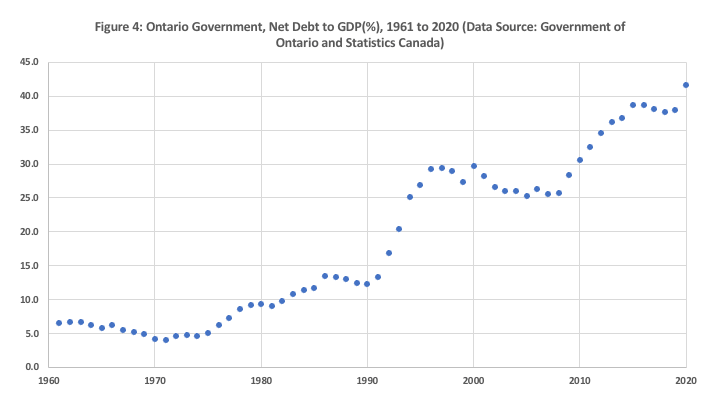
Figure 4

Declining long-term economic growth in Ontario has resulted in weaker growth in its tax base and government revenues, and yet Ontarians still want their government to provide health care, education and investment in new infrastructure in those sectors. Ontario governments have dealt with these demands to provide the public goods Ontarians want by essentially spending more than they take in. The result is structural deficits and mounting provincial government debt, as the chart below shows. The provincial net debt-to-GDP ratio has gone from about 5 per cent in the 1960s to about 40 per cent, followed by the pandemic bump above 40 per cent in 2020.

Yet, despite this run up in debt, Ontario’s government now spends (on a per-capita basis) some of the lowest amounts on health care and education in Canada.

Low economic growth rates, rising provincial government debt and an economy increasingly marked by a public fixated on real estate appreciation as a source of wealth-creation rather than productivity growth remains a recipe for a diminished future. The rebound in growth rates forecast for this year and next are being driven by a flood of cheap money that has generated widespread public and private borrowing and spending on housing to create an illusion of prosperity.

To have an economic future that’s sustainable and not a mirage, Ontario must boost its productive investment.

This originally appeared on the Fraser Institute Blog,  May 3rd, 2021.

Saturday, 8 April 2017

Evaluating Northern Ontario's Growth Plan-Part III: Investment Spending


This is the third in a series of posts in which I am presenting evidence evaluating the Growth Plan for Northern Ontario, which was released on March 4, 2011.  The 25-year plan was to guide provincial decision-making and investment in northern Ontario with the aim of strengthening the regional economy. The goal was strengthening the economy of the North by:
  • Diversifying the region's traditional resource-based industries
  • Stimulating new investment and entrepreneurship
  • Nurturing new and emerging sectors with high growth potential.
While the provincial government did commit itself to the development of performance measures for ministry specific initiatives that supported the implementation of the plan, I will be using a broader set of indicators of overall economic performance that are supported by the availability of readily accessible public data.  My first post was an overview of the series while my second post looked at employment. In this third post, I will be looking at new investment spending as measured by building permits.